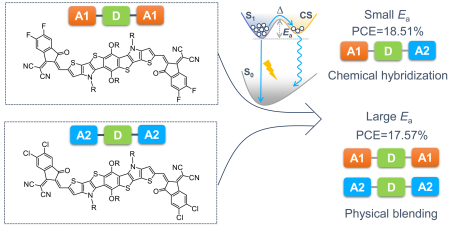
A novel asymmetric acceptor, M36-FCl, has been developed by chemically hybridizing two symmetric M-series acceptors: one featuring fluorinated terminal groups (M36F) and the other with chlorinated terminal groups (M36Cl). This asymmetric acceptor is systematically compared with an alloy-like composite formed by physically blending M36F with M36Cl to elucidate the advantages and limitations of the two strategies (chemical hybridization versus physical blending) in enhancing the photovoltaic performance of polymer solar cells (PSCs). Due to its asymmetric molecular structure, M36-FCl exhibits a large dipole moment and therefore has a higher relative dielectric constant of 4.85 compared to the composite acceptor (3.01). This higher dielectric constant can lower the energy barrier for exciton dissociation into free charges of the resulting devices. More importantly, the PM6:M36-FCl binary blend exhibits a more favorable morphology with greater crystallinity than the PM6:M36F:M36Cl ternary blend, resulting in reduced charge recombination and improved charge transport. Consequently, the optimal M36-FCl-based PSC achieves a power conversion efficiency (PCE) of 18.51%, surpassing the performance of the M36F:M36Cl-based counterpart, which has a PCE of 17.57%. The 18.51% PCE is the highest reported for all ADA-type non-fullerene acceptors (NFAs), highlighting the significant potential of the chemical hybridization strategy for tuning the properties of NFAs to enhance PSC performance.