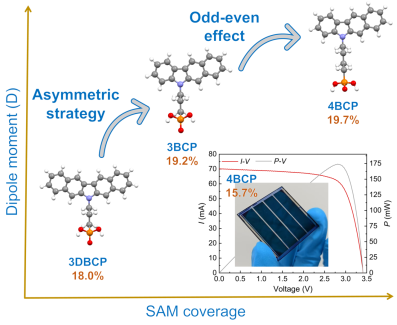
Self-assembled monolayers (SAMs) are pivotal in optimizing the performance of organic solar cells (OSCs) by minimizing interfacial energy losses, thereby enhancing overall device efficiencies. Herein, we develop three π-extended benzocarba-zole-based SAM molecules, 3DBCP, 3BCP, and 4BCP, as hole transport materials for OSCs. The absorption properties, solu-bility, magnitude and orientation of dipole moment, as well as energy level alignment of these molecules are meticulously tuned via the synergistic effects of asymmetric skeletons and odd-even effects. Among them, the asymmetric 4BCP, featuring an even-numbered carbon alkyl linker, exhibits enhanced solubility, a higher dipole moment, and more favorable energy lev-el alignment, thereby achieving superior surface coverage and uniformity on indium tin oxide electrodes. This optimized in-terface minimizes contact defects between the electrode and the active layer, facilitating improved hole extraction and col-lection. OSCs employing 4BCP achieve a striking power conversion efficiency (PCE) of 19.7%, coupled with excellent stor-age stability. Importantly, the scalability of this approach is also validated: a 1.10 cm² large-area device and an 11.09 cm² minimodule yield PCEs of 17.2% and 15.7%, respectively. These results highlight the practical potential of 4BCP to enable scalable, high-performance OSCs suitable for industrial application.